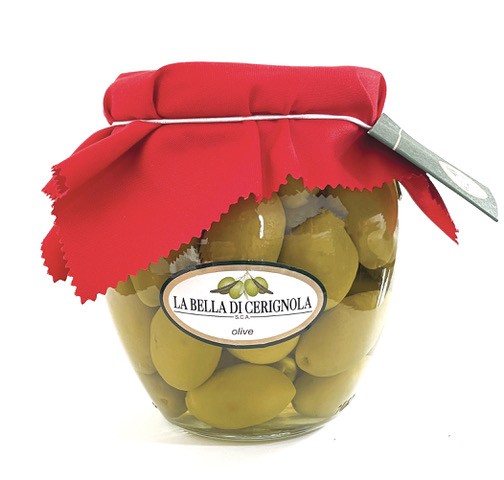
The cultivation of the Bella di Cerignola, one of the largest table olives in the world (GGG size), has very ancient origins. Some authors believe that this variety derives from the Orchie olives of ancient Rome, mentioned in the writings of Columella. Others believe that it was imported from Spain to the Cerignola area around 1400, which, in their opinion, would justify the synonym "Spanish olive" used in the past. Others, however, believe that the synonym "Spanish olive" derives from the type of processing used in Cerignola, namely the "Spanish" or "Seville" method. In any case, since a similar plant has never been found elsewhere, it can be considered a local variety in the province of Cerignola.
The cultivation of this olive has always been a major activity in Cerignola. Initially processed for domestic use, it gradually spread, thanks to migration, throughout the world, especially in the United States, until it became one of the most valuable table olives. As early as the late 19th century, Cerignola olives were transported to the eastern United States in small, conical wooden containers called "Cugnets" and in wooden barrels called "Vascidds".
The "Bella di Cerignola" olive, thanks to its nutritional value, deriving from the unique soil and climate in which it is grown, was registered in Europe in 2000 as "La Bella della Daunia DOP". Added to this value are its history, gastronomy, the beauty of the landscape, traditions, customs and the agricultural culture of the people. The best and largest olives, those that meet the requirements of the production regulations for the La Bella della Daunia PDO Bella di Cerignola variety, are processed and marketed by the cooperative as green and black olives bearing the prestigious European Protected Designation of Origin (PDO).
Production process / Processing for DOP
The cooperative processes Bella di Cerignola olives obtained exclusively from its members' fields, cultivated using traditional methods and in accordance with the production regulations for the DOP La Bella della Daunia, under the careful guidance of the cooperative's agricultural technicians and under the supervision of the AGROQUALITÀ body appointed by the Ministry of Agriculture, Food and Forestry.
The harvest begins at the beginning of October and is carried out manually to avoid damaging the olives. Special covers are also used to prevent the olives from coming into contact with the ground. Irrigation is stopped two weeks before harvest to prevent bruising that could occur as a result of excessive swelling of the olives due to prolonged irrigation.
After harvest, the olives are transported to the farm in special plastic crates for immediate processing. These details are very important, as they allow the cooperative to obtain a product that is both “intact” (without defects) and “fresh” (processed quickly). Once they arrive at the cooperative, the olives are sorted and separated based on size and degree of ripeness. The greenest olives are processed “in verde” (green), using the Sivigliano (Sevillian) method; the riper ones, with a wine-red color, are processed “in nero” (black), using the Californian method. The two methods mentioned above are applied in full compliance with the production regulations for the DOP La Bella della Daunia, under the careful guidance of the company's food technologist and under the supervision of the AGROQUALITÀ organization.
As mentioned, the green olives undergo a transformation process known as the Seville system, which eliminates the bitterness of the raw olives through the use of a sodium solution. This treatment lasts from eight to fifteen hours, depending on the temperature, the size of the olives and their degree of ripeness. Repeated washings are then carried out to eliminate the sodium. The olives are kept for at least thirty days in water and salt to allow fermentation, which gives them their characteristic green-straw yellow color, pleasant aroma and delicate flavor. After this stage, the olives are ready to be packaged in glass or metal containers. Containers that undergo heat treatment or pasteurization guarantee the consumer a safe product with constant organoleptic, olfactory and visual characteristics for a certain period of time.