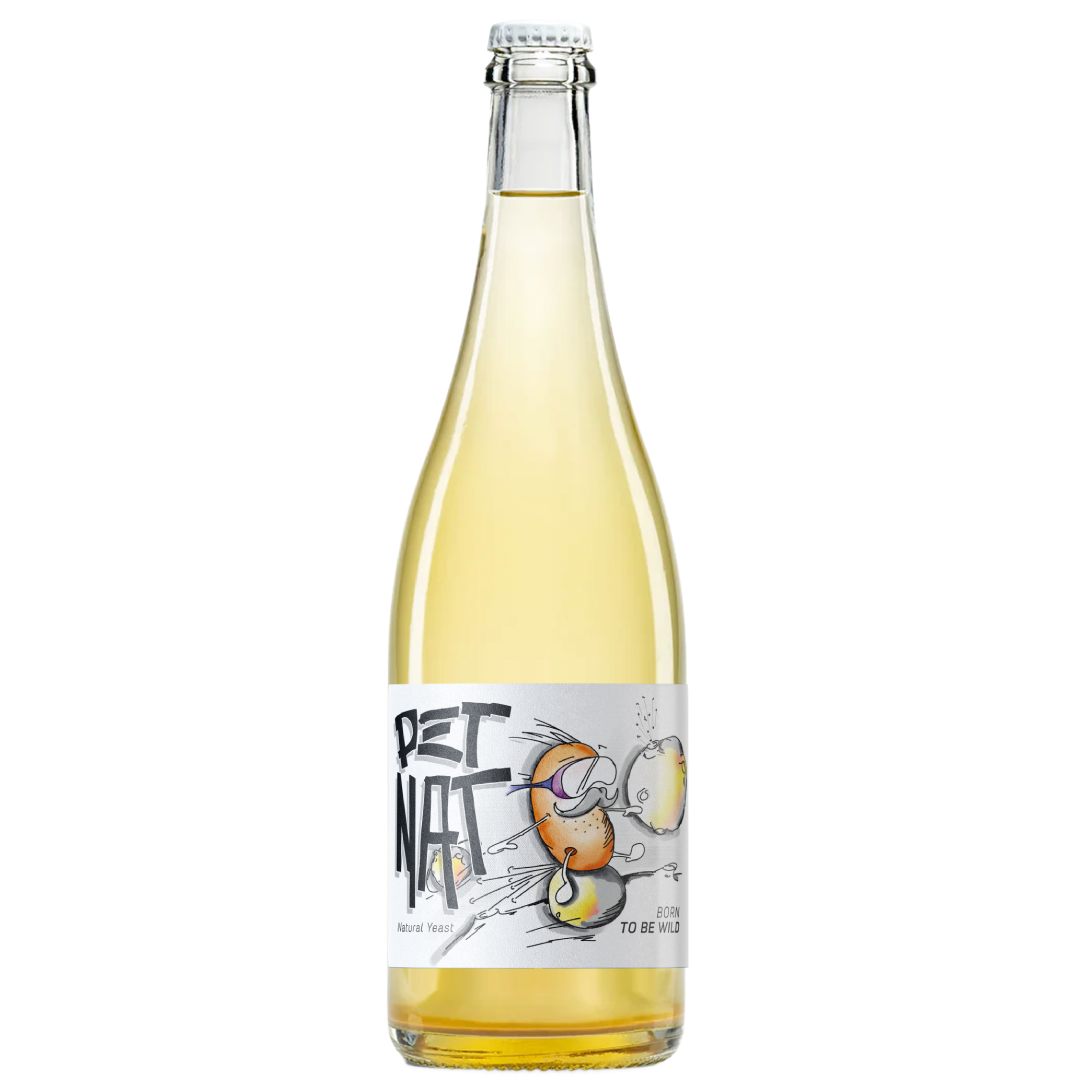
Type: natural semi-sparkling wine
Varieties: 50% Dimyat + 50% Rkatsiteli
Origin of grapes: organic grapes from own plantations, not irrigated
Vinification: The oldest natural method for sparkling wines is used, which relies solely on the quality of the grapes. Hand-picking is at the beginning of September and subsequent gentle pressing. The grape juice ferments spontaneously in stainless steel, and is bottled before the end of fermentation, thus continuing in the bottle and contributing to the formation of the desired carbonation naturally. Each bottle is disgorged before sale to remove the coarse sediment.
===
Pronounced Pet-Nat, is an abbreviation of the French Pétillant Naturel, which in Bulgarian means "naturally sparkling". This style of sparkling wine making originated in France and is known as the méthode ancestrale. Developed in the 16th century, it is the oldest method of making sparkling wine and results from a single, continuous alcoholic fermentation that is stopped about halfway through by lowering the temperature of the wine to a level where the yeast cells become dormant. The wine is then bottled (a period of aging before bottling is not excluded). Then, when the temperature of the wine rises again, the yeast wakes up and completes the conversion of sugar to alcohol, creating carbon dioxide (CO2) directly in the bottle. Because this fermentation is not primarily aimed at creating CO2 and no additional yeast or sugar is added, the wines are often only slightly sparkling compared to other sparkling wines.
Whether white, red, rosé or orange, Petite Nat wines are often cloudy as a result of the lees that are not filtered. In this way, these Pet-Nat wines are visually distinct from the crystal clear Prosecco and Champagne. An exception is made by some resourceful producers who partially remove the lees in order to offer clearer wines.
Many Pet-Nat producers in Europe have chosen to cultivate their vineyards using organic or biodynamic methods, following a philosophy of minimal chemical intervention in the winemaking process from the vineyard to the finished product.
Pet-Nats have less pressure and therefore appear lighter, with often less pronounced perlage (carbonation). Their pressure in the bottle is usually 2.5-3 bar, while Champagne is around 5-6 bar. The alcohol content is also often lower than in other sparkling wines. The typical Pet-Nat is slightly sweet, although there are also “dry” examples, and is cloudy due to the presence of remaining lees and the lack of filtration. Unlike Champagne and Prosecco, Pet-Nat does not undergo a second fermentation, in which sugar and yeast are added to the champagne wine. In the production of Pet-Nat, the natural fermentation is interrupted, the wine is bottled and fermentation is completed in the bottle.
The packaging also often differs in one important detail: Champagne is closed with the characteristic large corks with a wire "basket". Pet-Nats, on the other hand, are usually closed with a cap similar to a beer or soft drink bottle.