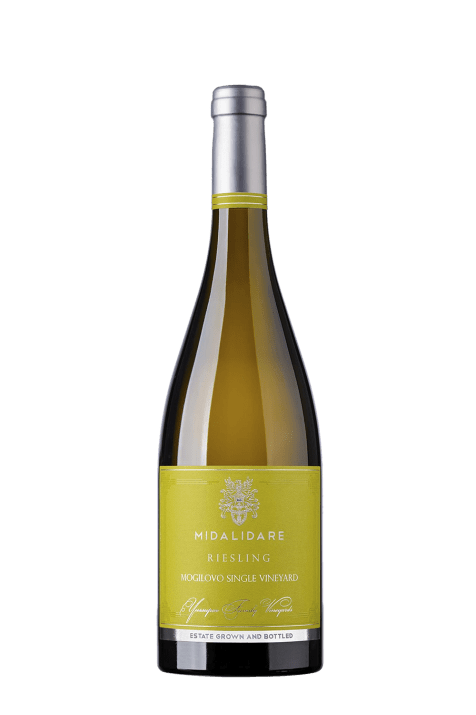
The Midalidare series of wines of the same name is a kind of homage to the natural features and climatic conditions characteristic of the village of Mogilovo. Part of the company's winemaking philosophy is to grow only grape varieties suitable for the unique terroir of the winery. The Midalidare series of wines presents the unique features of the region in combination with the varietal characteristics of the grapes. Midalidare are terroir wines that express the specifics of the varieties, individually or in a blend. The charm of this series is visually supported by the beautiful single-color labels of the wines: each variety or blend has its own unique color.
The green color is reserved for an exceptional aristocrat - Riesling.
Variety: 100% Riesling.
Terroir: Riesling is planted on the northeastern slopes of the Prisovete vineyard, at an altitude of 340-360 meters above sea level. The soils in this part of the Prisovets are alluvial and cinnamon forest, strong to medium clayey. The plantations are surrounded by forest on three sides and thus the vines receive limited sunshine and the grapes ripen later, which is a prerequisite for preserving the acid content and greater potential for aging. The terroir features in Mogilovo include: pronounced temperature amplitudes; optimal ratio of sunshine and precipitation, mild winters and warm summers.
Viticulture: The plants are of French origin, with an average age of 10 years. The formation is single Guyot (vertical shoot positioning), the density is about 5000 plants per hectare. The yield is controlled. The regulation of production is one-time, when the shoots are 15 -20 cm high, the so-called green pruning.
Bertiba: The harvest for Midalidare Riesling takes place in the early morning hours, at the end of September to the beginning of October, entirely by hand in 10-12 kg boxes.
Vinification: The harvested grapes are immediately transported and cooled in a cold room for 24 hours. They are sorted manually in two stages: first the whole bunches are sorted, the bunches are separated and the sorting of the grapes begins. The harvested and selected grapes are gravity fed into a press to separate the grape juice. A cold maceration is carried out in order to extract the maximum aromas from the skins. Then it is drained and delicately pressed in a stainless steel container. For a period of several days the juice remains in the container to clarify, then it is decanted into a new container and inoculated with yeast. Slow alcoholic fermentation begins at a controlled temperature. After fermentation is complete, the wine is cooled and left on the lees for a certain period of time, with batonnage (lifting of the lees) performed if necessary. The process ends with the separation of the wine from the lees. This is followed by filtration, clarification and bottling.
Organoleptic characteristics
Color: brilliant, pure light yellow with delicate gray hues
Aroma: varietal nose, typical of young Riesling, with a persistent aroma of candied lemon and green apple, which transitions into an ethereal petroleum tone with hints of acacia and green herbs
Taste: fresh, tight and elegant in the mouth, promising magnificent development in the coming years; excellently balanced, with a citrus flavor, and the long mineral finish flows into a citrus-herbal aftertaste.
Food Pairings: Pairs beautifully with spicy, savory, and layered cuisines such as Indian, Asian, Spanish, and American, as well as simple dishes such as Alsatian stew; seafood, shellfish, and molluscs; mustard pretzels; grilled sausages; pickled foods.
* Recommended serving in (high stool, small balloon, narrow mouth, tulip), (high stool, narrow balloon, narrow mouth) or a standard white wine glass.
Serving temperature: 8-10°C.
Aging potential: 10+ years